
Life-Size Dance: Improvisation, Somaesthetics, and the Practice of Toru Iwashita
DOI:
https://doi.org/10.54337/ojs.jos.v11i2.10828Abstract
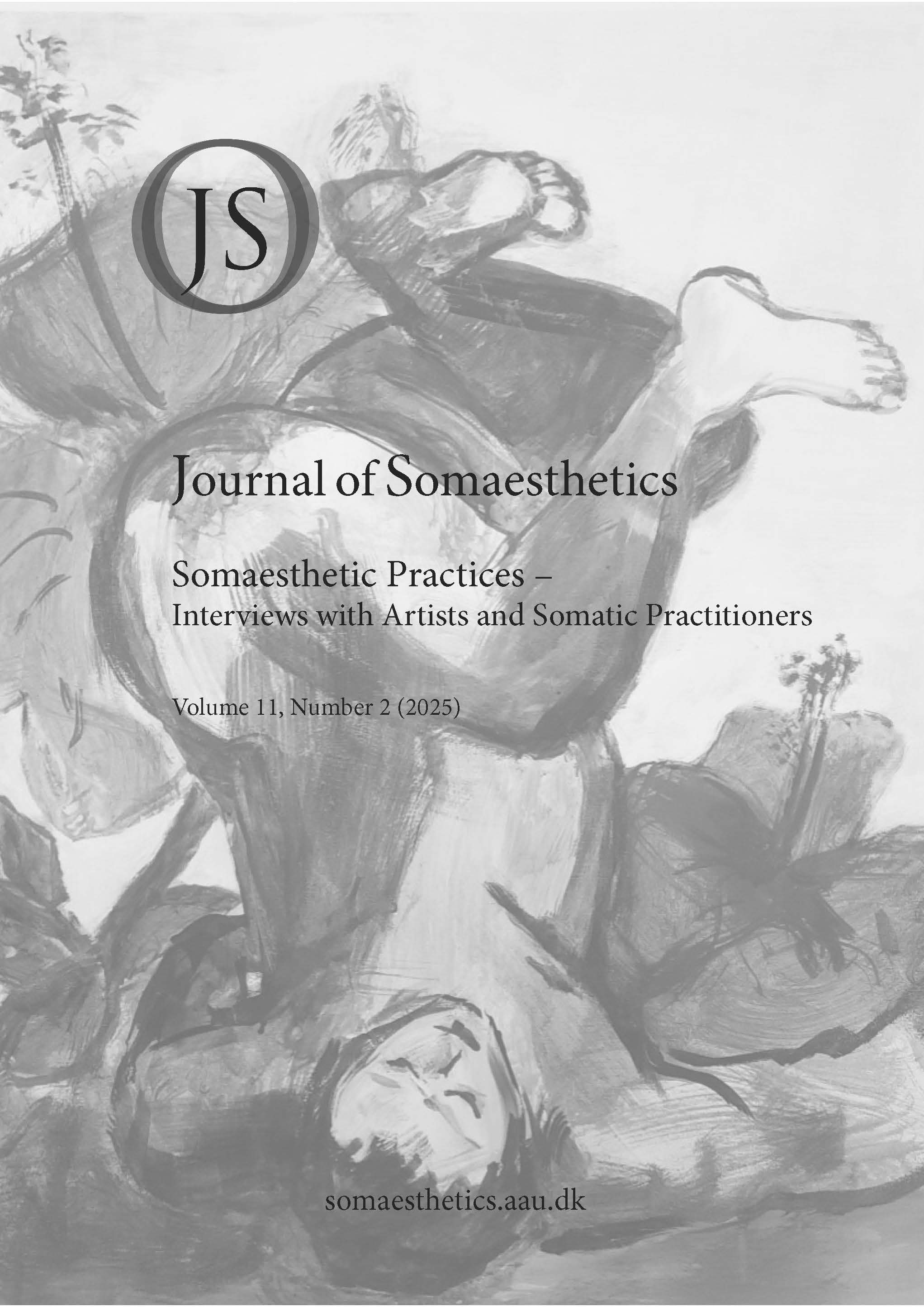
Toru Iwashita, born in Tokyo in 1957, is a dancer specializing in Butoh and improvisational dance. From the 1980s until 2024, he performed with the internationally renowned troupe Sankai Juku while also developing a parallel solo practice. He continues to be active today, presenting numerous improvisational works Since the 1980s, Iwashita has also led dance therapy workshops, including long-term work at a psychiatric ward in Saga Prefecture. He has explored improvisation as a form of empathetic communication—with oneself, others, and the world. His “life-size” dance is based on everyday movements such as lying down, rolling, or standing up, rooted in his own experience of overcoming a mental health crisis by reconnecting with his body. Evolving from “dance as a scream” to “dance as communication,” his improvisation seeks states where the self emerges and is pushed out through the body, moving beyond choreographed form or representation.
References
Gibson, J. (1979). The theory of affordances. The Ecological Approach to Visual Perception, Boston: Houghton Mifflin, 127-137.
Iwashita, T. (2001). Sukoshi zutsu jiyū ni naru tame ni: Kyōkan toshite no sokyū dansu o motomete [Toward Becoming Free Little by Little: Improvisational Dance as Empathy]. Gendai no esupuri [Contemporary Esprit], 413, 165-176.
Iwashita, T. (2019). Watashi wa naze odoru no ka? [Why Do I Dance?]. Mind-Body Science, 29, 14-17.
Kinoshita, S. (2016). Mou hitotsu no tai: Ningen no shizen [In a Different Voice of Human Nature]. Jomin bunka, 39, 35-51.
Kokubun, K. (2017). Chudotai no sekai: Ishi to sekinin no kokogaku [The World of Middle Voice: Archaeology of Will and Responsibiility]. Tokyo: Igakushoin.
Mikami, K. (1993). Utsuwa to shinta: hijikata tatsumi・ankoku butoh giho e no approach [Vessel and Body: An Approach to Hijikata Tatsumi’s Ankoku Butoh Techniques]. Tokyo: Namishobo.
Nishimura, K. (1989). Asobi no genshogaku [Phenomenology of Play]. Tokyo: Keiso shobo.
Shusterman, R. (2012). Thinking through the body: Essays in somaesthetics. New York: Cambridge University Press.
Downloads
Published
Issue
Section
License
Copyright (c) 2026 Jiyun Bae

This work is licensed under a Creative Commons Attribution-NonCommercial-NoDerivatives 4.0 International License.
Articles published in The Journal of Somaesthetics are following the license Creative Commons Attribution-NonCommercial-NoDerivs 4.0 Unported (CC BY-NC-ND 4.0). Authors retain copyright and grant the journal right of first publication with the work simultaneously licensed under a Creative Commons Attribution License: Attribution - NonCommercial - NoDerivs (by-nc-nd). Further information about Creative Commons
If excerpts, tables, figures, charts, artwork or photographs from other copyrighted works are included in an article, it is the author’s responsibility to obtain written permission from the copyright owners and credit the source’s in the article and citation list.