
PAC Learning Or: Why We Should (and Shouldn't) Trust Machine Learning
Article Sidebar
Main Article Content
Abstract
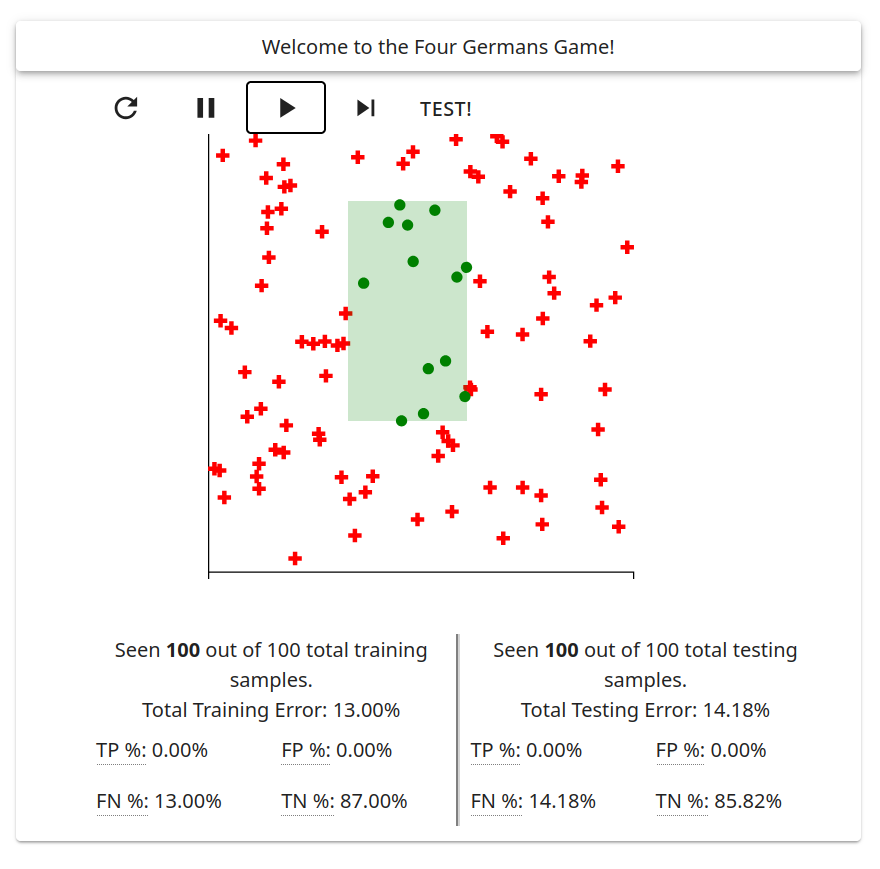
In this interactive article, we present an interactive game that represents the types of tasks solved by machine learning algorithms. We use this game to motivate the definition of Probably Approximately Correct (PAC) learning, illustrating a proof of PAC learnability for Empirical Risk Minimization (ERM). Then, we show three types of vulnerabilities of ERM that often occur in applied machine learning - domain mismatch, dependencies in data, and an incorrect model class. We conclude by arguing for the need for visualization to identify these issues in a modeling dataset.
Article Details

This work is licensed under a Creative Commons Attribution-ShareAlike 4.0 International License.
References
Blumer, Anselm, et al. “Learnability and the Vapnik-Chervonenkis dimension.” Journal of the ACM (JACM) 36.4 (1989): 929-965. DOI: https://doi.org/10.1145/76359.76371
Valiant, Leslie G. “A theory of the learnable.” Communications of the ACM 27.11 (1984): 1134-1142. DOI: https://doi.org/10.1145/1968.1972
Kearns, Michael J., and Umesh Vazirani. “An introduction to computational learning theory.”″ MIT press, 1994. DOI: https://doi.org/10.7551/mitpress/3897.001.0001
Feng, Alice, et al. “The myth of the impartial machine.” The Parametric Press (2019). DOI: https://doi.org/10.5281/zenodo.2655980
Vapnik, Vladimir. “Principles of risk minimization for learning theory.” Advances in neural information processing systems 4 (1991). DOI: https://dl.acm.org/doi/10.5555/2986916.2987018
Varshney, Kush R., and Homa Alemzadeh. “On the safety of machine learning: Cyber-physical systems, decision sciences, and data products.” Big data 5.3 (2017): 246-255. DOI: https://doi.org/10.1089/big.2016.0051
Valiant, Leslie. “Probably approximately correct: nature’s algorithms for learning and prospering in a complex world.” (2013). DOI: https://dl.acm.org/doi/10.5555/2765677
Adiga, Abhijin, et al. “PAC learnability of node functions in networked dynamical systems.” International Conference on Machine Learning. PMLR, 2019.
Shao, Han, Omar Montasser, and Avrim Blum. “A theory of pac learnability under transformation invariances.” Advances in Neural Information Processing Systems 35 (2022): 13989-14001. DOI: https://dl.acm.org/doi/10.5555/3600270.3601287
Badue, Claudine, et al. “Self-driving cars: A survey.” Expert Systems with Applications 165 (2021): 113816. DOI: https://doi.org/10.1016/j.eswa.2020.113816
Kwon, Joon-myoung, et al. “Validation of deep-learning-based triage and acuity score using a large national dataset.” PloS one 13.10 (2018): e0205836. DOI: https://doi.org/10.1371/journal.pone.0205836
Wu, Shaobing, et al. “Crime prediction using data mining and machine learning.” The 8th International Conference on Computer Engineering and Networks (CENet2018). Springer International Publishing, 2020. DOI: https://doi.org/10.1007/978-3-030-14680-1_40
Fujiyoshi, Hironobu, Tsubasa Hirakawa, and Takayoshi Yamashita. “Deep learning-based image recognition for autonomous driving.” IATSS research 43.4 (2019): 244-252. DOI: https://doi.org/10.1016/j.iatssr.2019.11.008
Buolamwini, Joy, and Timnit Gebru. “Gender shades: Intersectional accuracy disparities in commercial gender classification.” Conference on fairness, accountability and transparency. PMLR, 2018.
Wolpert, David H., and William G. Macready. “No free lunch theorems for optimization.” IEEE transactions on evolutionary computation 1.1 (1997): 67-82. DOI: https://dl.acm.org/doi/abs/10.1109/4235.585893
Wolpert, David H. “What is important about the no free lunch theorems?.” Black box optimization, machine learning, and no-free lunch theorems. Cham: Springer International Publishing, 2021. 373-388. DOI: https://doi.org/10.48550/arXiv.2007.10928
Tabacof, Pedro, and Eduardo Valle. “Exploring the space of adversarial images.” 2016 international joint conference on neural networks (IJCNN). IEEE, 2016. DOI: https://doi.org/10.1109/IJCNN.2016.7727230