
Greetings From. . . A Workshop to Visualise Unexpected Stories of a Place Through Data Postcards
Article Sidebar
Main Article Content
Abstract
Introduction Greetings from. . . is an exploratory format in which data visualisation becomes a tool for a critical analysis of realities, sounds, scents, and rhythms. Developed within the framework of the Innovation Design Lab in Turin (Italy), the format follows the Systemic Innovation Design Methodology to create a Databook. The methodology transforms data into information, knowledge, and actionable insights for territorial design proposals with an innovative perspective.
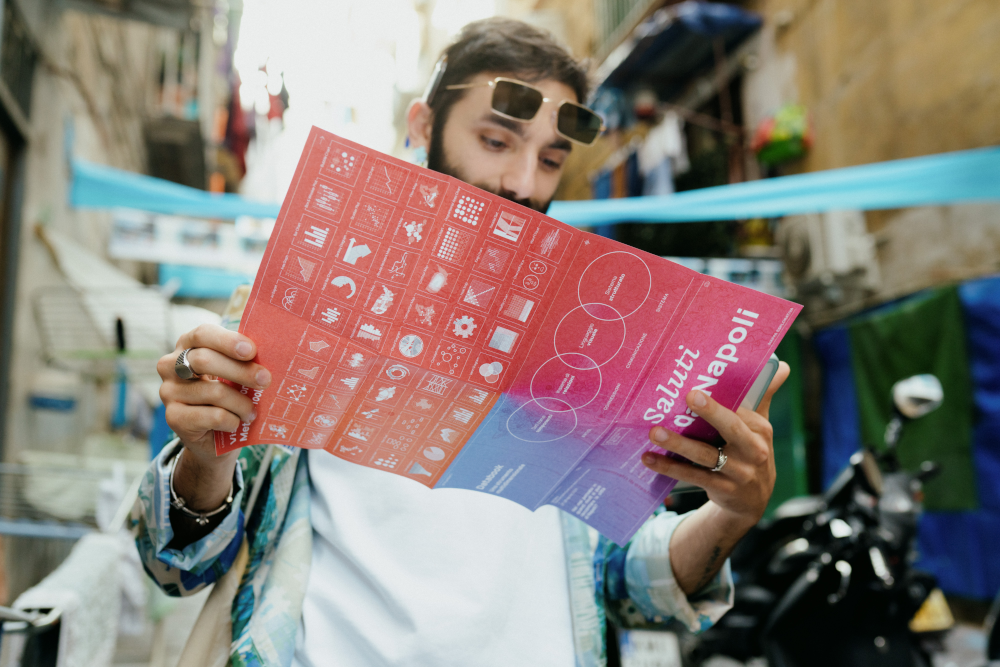
Data collection By presenting the workshop Greetings from Naples, we present a holistic analysis as a virtuous process of data collection, mapping, and visualisation that describes a context or territory. During a three-day workshop, students with diverse backgrounds challenged themselves to create data visualisations using postcards as a medium. They explored the neighbourhood of Quartieri Spagnoli (Naples), identifyingtheir visual interpretation and collecting as much data as possible through different media.
Data analysis Participants visualized the data on postcards. Different shapes, colours, and graphical representations helped them identify emerging patterns and behaviours.
Analysis results Collecting all the postcards generated a collective databook, where multiple points of view create a sudden and not-so-common vision of the surroundings. We observe the impact of visual components and territorial factors as drivers of visualisation design approaches.
Conclusion We discuss the format’s implications and opportunities as a replicable model for exploring and understanding urban contexts and facilitating design strategies through insightful data visualisation.
Article Details

This work is licensed under a Creative Commons Attribution-ShareAlike 4.0 International License.
References
[1] Russell L Ackoff. 1989. From data to wisdom. Journal of applied systems analysis 16, 1 (1989), 3–9.
[2] Rahul Bhargava, Dee Williams, and Catherine D’Ignazio. 2021. How Learners Sketch Data Stories. In 2021 IEEE Visualization Conference (VIS). 196–200. https://doi.org/10.1109/VIS49827.2021.9623299 DOI: https://doi.org/10.1109/VIS49827.2021.9623299
[3] Vetria L Byrd. 2021. Using Dear Data Project to Introduce Data Literacy and Information Literacy to Undergraduates. In Advances in Software Engineering, Education, and e-Learning: Proceedings from FECS’20, FCS’20, SERP’20, and EEE’20. Springer, 131–142. https://doi.org/10.1007/978-3-030-70873-3_10 DOI: https://doi.org/10.1007/978-3-030-70873-3_10
[4] Alberto Cairo. 2012. The Functional Art: An introduction to information graphics and visualization. New Riders.
[5] Sofia Cretaio, Sergio Degiacomi, Leonardo Moiso, Cristina Marino, Chiara Remondino, Paolo Tamborrini, et al. 2023. Databook design per fare innovazione. Uno strumento di ricerca e analisi per attivare progettualità sostenibili. In DesignIntorno. Atti della Conferenza annuale della Società Italiana di Design. Società Italiana di Design, 445–455.
[6] Andrea Di Salvo, Cristina Marino, Paolo Marco Tamborrini, et al. 2024. Dati e Persona/ggi. La narrazione come strumento strategico per esplorare unicità e complessità del territorio. In Design per la Diversità. Atti della Conferenza Nazionale SID 2023. SID Società Italiana Design, 176–185.
[7] Merriam-Webster Dictionary. [n. d.]. workshop. Retrieved April 02, 2024 from https://www.merriam-webster.com/dictionary/workshop
[8] Banu Inanc Uyan Dur. 2014. Data visualization and infographics in visual communication design education at the age of information. Journal of arts and humanities 3, 5 (2014), 39–50. https://doi.org/10.18533/journal.v3i5.460
[9] DESINA Festival. 2023. Festival della grafica delle culture visive 01. Retrieved April 10, 2024 from https://2023.desina.it/
[10] Andrea Gaiardo, Chiara Lorenza Remondino, Barbara Stabellini, Tamborrini Paolo, et al. 2022. Il design è innovazione sistemica. Metodi e strumenti per gestire in modo sostenibile la complessità contemporanea: il caso Torino. LetteraVentidueEdizioni.
[11] Andrea Gaiardo, Paolo Tamborrini, et al. 2015. Systemic Innovation design methodology: the comparison of two cases studies. Proceedings of the 11th European Academy of Design Research, Paris, France (2015), 22–24.
[12] Caracol Art Gallery. 2021. “Saluti Baci” l’art-graphic journalism secondo da Daniele Catalli. Retrieved April 10, 2024 from https://caracolarte.it/saluti-baci-lart-graphic-journalism-secondo-da-daniele-catalli/
[13] Denise Hattwig, Kaila Bussert, Ann Medaille, and Joanna Burgess. 2013. Visual literacy standards in higher education: New opportunities for libraries and student learning. portal: Libraries and the Academy 13, 1 (2013), 61–89. https://doi.org/10.1353/pla.2013.0008 DOI: https://doi.org/10.1353/pla.2013.0008
[14] Rob Kitchin. 2014. Big Data, new epistemologies and paradigm shifts. Big data & society 1, 1 (2014), 2053951714528481. DOI: https://doi.org/10.1177/2053951714528481
[15] David A Kolb. 2014. Experiential learning: Experience as the source of learning and development. FT press.
[16] Nicole Lachenmeier and Darjan Hil. 2022. Visualizing Complexity. Birkhäuser.
[17] Giorgia Lupi and Stefanie Posavec. 2016. Dear data. Chronicle books.
[18] Wolfgang Maass, Jeffrey Parsons, Sandeep Purao, Veda C Storey, and Carson Woo. 2018. Data-driven meets theory-driven research in the era of big data: Opportunities and challenges for information systems research. Journal of the Association for Information Systems 19, 12 (2018), 1. https://doi.org/10.17705/1jais.00526 DOI: https://doi.org/10.17705/1jais.00526
[19] Lorenzo Marchionni. 2021. Tanti cari saluti. Il Saggiatore.
[20] Claudia Mitchell. 2011. Doing visual research. Sage.
[21] Francesca Morini, Anna Eschenbacher, Johanna Hartmann, and Marian Dörk. 2024. From shock to shift: Data visualization for constructive climate journalism. IEEE transactions on visualization and computer graphics 30, 1 (2024), 1413–1423. https://doi.org/10.1109/TVCG.2023.3327185 DOI: https://doi.org/10.1109/TVCG.2023.3327185
[22] Lene Nielsen. 2004. Engaging personas and narrative scenarios. (2004).
[23] Lene Nielsen and Kira Storgaard Hansen. 2014. Personas is applicable: a study on the use of personas in Denmark. In Proceedings of the SIGCHI Conference on Human Factors in Computing Systems. 1665–1674. https://doi.org/10.1145/2556288.2557080 DOI: https://doi.org/10.1145/2556288.2557080
[24] Jan-Ola Östman. 2004. The postcard as media. Text & Talk 24, 3 (2004), 423–442. https://doi.org/10.1515/text.2004.017 DOI: https://doi.org/10.1515/text.2004.017
[25] Marina Parente and Carla Sedini. 2017. Design for Territories as practice and theoretical field of study. The Design Journal 20, sup1 (2017), S3047–S3058. DOI: https://doi.org/10.1080/14606925.2017.1352812
[26] Marina Parente and Carla Sedini. 2017. PAD# 13: Design for territories. Vol. 13. LetteraVentidue Edizioni.
[27] John Pruitt and Jonathan Grudin. 2003. Personas: practice and theory. In Proceedings of the 2003 conference on Designing for user experiences. 1–15. DOI: https://doi.org/10.1145/997078.997089
[28] Chiara L Remondino, Paolo Tamborrini, and Wouter Meys. 2019. Visualisation Method Toolkit: a shared vocabulary to face complexity. (2019). https://doi.org/10.21606/learnxdesign.2019.13039 DOI: https://doi.org/10.21606/learnxdesign.2019.13039
[29] Jonathan C. Roberts, Chris Headleand, and Panagiotis D. Ritsos. 2016. Sketching Designs Using the Five Design-Sheet Methodology. IEEE Transactions on Visualization and Computer Graphics 22, 1 (2016), 419–428. https://doi.org/10.1109/TVCG.2015.2467271 DOI: https://doi.org/10.1109/TVCG.2015.2467271
[30] Bjarne Rogan. 2005. An entangled object: The picture postcard as souvenir and collectible, exchange and ritual communication. Cultural Analysis 4, 1 (2005), 1–27. https://api.semanticscholar.org/CorpusID:49086301
[31] Simone Sbarbati. 2017. Cartoleena: su Instagram, l’analisi semiotica delle cartoline brutte. Retrieved April 16, 2024 from https://www.frizzifrizzi.it/2017/07/21/cartoleena-instagram-lanalisi-semiotica-delle-cartoline-brutte/
[32] Simone Sbarbati. 2020. Saluti e baci: grazie a Daniele Catalli puoi inviare una cartolina illustrata a un* negazionista (o a chi vuoi). Retrieved April 16, 2024 from https://www.frizzifrizzi.it/2020/12/18/saluti-e-baci-grazie-a-daniele-catalli-puoi-inviare-una-cartolina-illustrata-a-un-negazionista-o-a-chi-vuoi/
[33] Barbara Stabellini, Paolo Tamborrini, and Andrea Di Salvo. 2019. The Design Value of the Relationship Between Personal and Urban Data: Volume X: Auditory and Vocal Ergonomics, Visual Ergonomics, Psychophysiology in Ergonomics, Ergonomics in Advanced Imaging. 144–150. https://doi.org/10.1007/978-3-319-96059-3_16 DOI: https://doi.org/10.1007/978-3-319-96059-3_16
[34] Karen Swan, Philip J Vahey, Ken Rafanan, and Tina Stanford. 2009. Challenges to cross-disciplinary curricula: Data literacy and divergent disciplinary perspectives. In Annual Conference of the American Educational Research Association. San Diego, CA. Retrieved from https://www.sri.com/publication/education-learning-pubs/challenges-to-cross-disciplinary-curricula-data-literacy-and-divergent-disciplinary-perspectives/.
[35] Paolo Tamborrini, Barbara Stabellini, et al. 2018. Metodologie e strumenti per l’innovazione sostenibile. MD JOURNAL 5 (2018), 50–57.
[36] Leo Van Audenhove, Wendy Van den Broeck, and Ilse Mariën. 2020. Data literacy and education: Introduction and the challenges for our field. Journal of Media Literacy Education 12, 3 (2020), 1–5. https://doi.org/10.23860/JMLE-2020-12-3-1 DOI: https://doi.org/10.23860/JMLE-2020-12-3-1
[37] Jagoda Walny, Samuel Huron, and Sheelagh Carpendale. 2015. An exploratory study of data sketching for visual representation. In Computer Graphics Forum, Vol. 34. Wiley Online Library, 231–240. https://doi.org/10.1111/cgf.12635 DOI: https://doi.org/10.1111/cgf.12635
[38] Annika Wolff, Daniel Gooch, Jose J Cavero Montaner, Umar Rashid, and Gerd Kortuem. 2016. Creating an understanding of data literacy for a data-driven society. The Journal of Community Informatics 12, 3 (2016). https://doi.org/10.15353/joci.v12i3.3275 DOI: https://doi.org/10.15353/joci.v12i3.3275